
Field Dialogue on Ecosystem
Restoration
Delegation report
I. Summary of the event
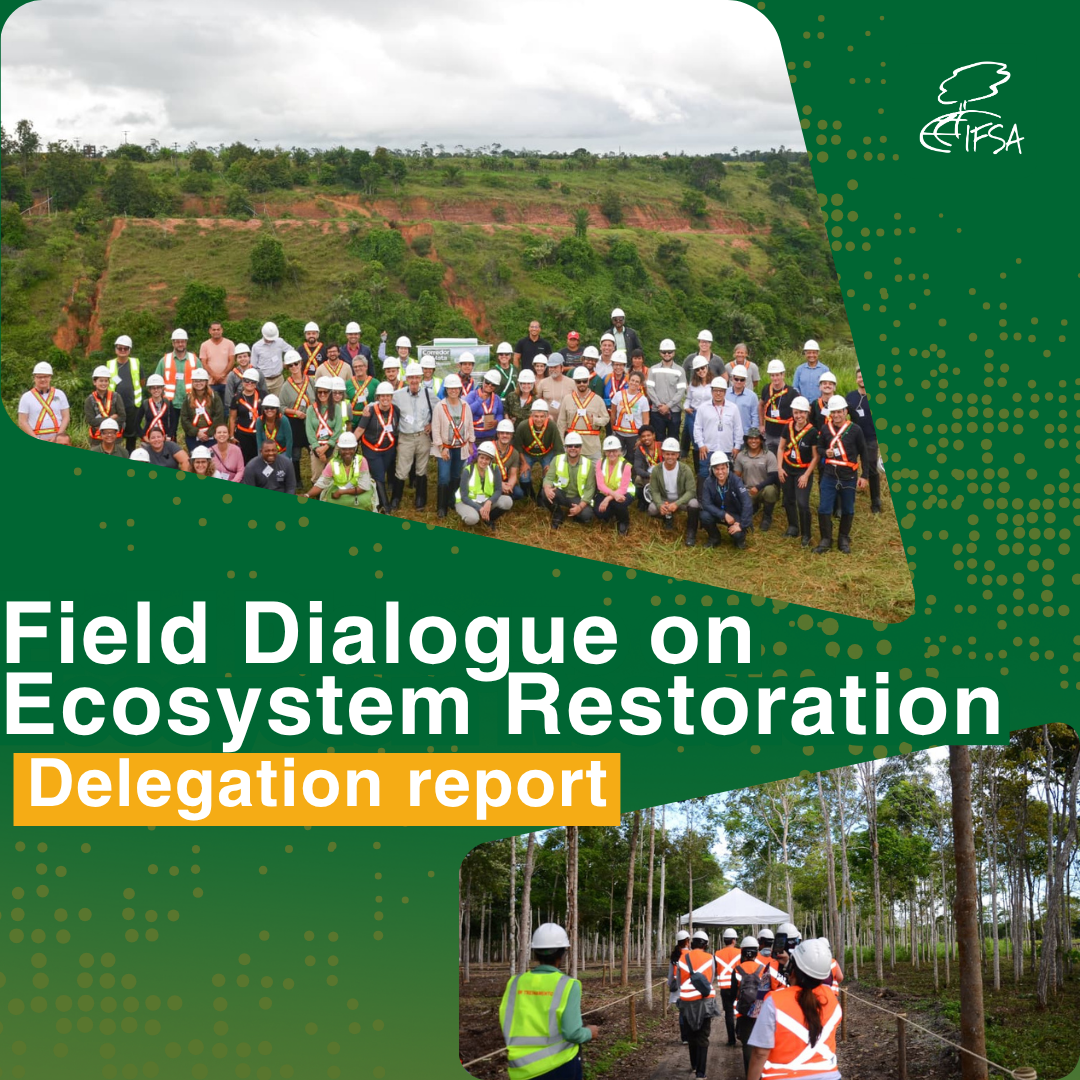
The Field Dialogue on Ecosystem Restoration was organized by The Forests Dialogue, Diálogo Florestal, and Fórum Florestal da Bahia, from 4–7 May 2026 in the Porto Seguro region, Bahia State, Brazil. The dialogue brought together participants from Brazil and different parts of the world to exchange perspectives and experiences related to ecosystem restoration, especially on how restoration efforts in Bahia could contribute to broader global restoration discussions. The event combined field visits and dialogue sessions. During the field visits, participants directly visited restoration sites and engaged with local communities and practitioners to better understand the realities, challenges, and opportunities of ecosystem restoration on the ground. The dialogue sessions then provided space for participants to reflect together through plenary discussions and smaller group conversations on topics such as restoration governance, private sector engagement,
local livelihoods, financing, and collaboration across sectors.
A total of 56 participants joined the dialogue, representing a wide range of stakeholders. The majority came from NGOs, civil society organizations, and restoration networks, with representatives from organizations such as World Wide Fund for Nature (WWF), Forest Stewardship Council (FSC Brazil), Forest Peoples Programme, The Nature Conservancy (TNC), Instituto Socioambiental, Diálogo Florestal, and several restoration coalitions and community-based organizations. Participants from the private sector and industry were also strongly represented through companies such as Suzano, Bracell, CMPC, Veracel, Klabin, and Sumitomo Forestry, alongside restoration-focused enterprises such as Re.Green and Morfo. The dialogue also involved researchers and academics from institutions including Yale University and Universidade Federal do Sul da Bahia, as well as Indigenous and community representatives such as FINPAT and Associação do povo Borum-Kren. Youth participation was represented by delegates from International ForestryStudents & Association (IFSA). Through its participation, IFSA brought the perspective of forestry students and young people into discussions that are often dominated by institutions, industry actors, and senior experts. IFSA emphasized the importance of involving young people more meaningfully in decision-making spaces related to ecosystem restoration.
II. Delegation
Head of Delegation : Canakya Galerita (female) — Asia Pacific region
National Delegate : Laura Aluotto de Oliveira (female) — Latin America region
III. Experience
Sessions attended
Summary of the sessions attended by IFSA delegates during the event and brief remarks. It shall contain:
● Name of the session
● Description of the session
● IFSA led-session
● Delegate(s) that participated and their role
● Learning outcomes
1. Welcome Dinner
The reception dinner began with opening speeches given by Gary Dunning (The Forests Dialogue), Fernanda Rodrigues (Brazilian Forests Dialogue), and Erica Munaro (Bahia Forest Forum). They highlighted the dialogue’s objectives and outlined the agenda for the week. Moreover, Gary emphasized ground rules for the event, mainly, the Chatham House Rule. This rule is crucial for encouraging open discussion, it states that participants are free to use information learned from the dialogue, but restricts them from sharing the identity or affiliation of the speakers. Shortly after, all of the Co-Chairs and participants quickly introduced themselves. Finally, Daniel Piotto (Southern Bahia’s Federal University) presented the main ideas present in the background paper to help all participants understand the context of restoration in southern Bahia.
2. Field Visits – Day 1
● Fábio Santos Settlement
The second day began with a visit to the Fábio Santos Settlement in Teixeira de Freitas, Bahia, where participants met with local community representatives from the Landless Rural Workers’ Movement (MST). The settlement consists of around 96 families managing different agricultural activities such as coffee, watermelon, pumpkin, and dairy production, while also taking part in restoration efforts through the Atlantic Forest Corridor. During the visit, participants explored restoration areas within Corredor da Mata and Corredor Alcoprado and learned how the community has contributed to restoring more than 200 hectares through approaches such as assisted natural regeneration, enrichment planting, no-till farming, and agroforestry systems. Discussions throughout the day also highlighted collaboration between communities, restoration partners, and private sector actors such as Suzano, which has committed to connecting 500,000 hectares of priority
forest fragments for biodiversity conservation by 2030 through ecological corridors across Brazil. For IFSA delegates, the visit provided a valuable perspective on how restoration is closely connected with local livelihoods, long-term stewardship, and collective community action. Seeing communities directly involved in setting restoration goals, managing seedlings, and maintaining agroforestry systems
showed how restoration efforts can develop through strong local ownership and collaboration across multiple stakeholders.
● Suzano Restoration Sites
Next, participants visited restoration sites managed by Suzano, where discussions focused on how ecological restoration is being integrated within production landscapes and eucalyptus plantation management. During the visit, Suzano representatives explained the restoration process taking place in protected areas such as APPs and Legal Reserves, including at Alcoprado Farm, an area of around 93.9 hectares currently under restoration. Participants learned that before being restored, the area had previously been used as pastureland, which led to significant degradation and required environmental recovery efforts aligned with Brazil’s Forest Code. The discussions also highlighted Suzano’s broader restoration commitment, including its 2026 target to restore 3,127 hectares, with 913 hectares already achieved by April 2026. Walking directly through the restoration sites gave participants a clearer picture of how large-scale companies approach restoration planning, monitoring, and implementation within operational landscapes. For IFSA delegates, one of the main takeaways from the visit was understanding how restoration commitments from the private sector can move beyond targets on paper and become visible through on-ground implementation, long-term management, and collaboration with local partners and surrounding communities.
3. Field Visits – Day 2
Pau Brasil National Park
The second day of field visits began at Pau Brasil National Park, named after the Paubrasilia echinata tree, which is deeply connected to Brazil’s history. The participants were welcomed by the park’s team, who provided more information about its management, history, and connection with surrounding communities. Established in 1999, the park’s original area covered approximately 11.500 hectares, but in 2010 it was expanded and now spans nearly 19.000 hectares. Part of the expansion took place in areas previously occupied by eucalyptus plantations, which required restoration. Following the reception, participants visited the restoration areas and were guided by the Natureza Bela Environmental Group, the Public Interest Civil Society Organization responsible for carrying out the restoration. The restoration project is led by Conservation International and financed by Mastercard. Moreover, it combines two restoration techniques, Total Planting Restoration and Assisted Natural Regeneration, initiated in 2022 and 2024, respectively. This visit enabled IFSA delegates to compare the two restoration techniques and reflect upon how civil society can engage and benefit from restoration initiatives, especially in public-managed areas.
● Symbiosis Restoration Initiative
Following lunch, participants proceeded to Symbiosis, a large-scale restoration company. Symbiosis was founded in 2008 with the goal of making restoration financially viable by selling high-quality timber extracted from native species. The visit was divided into three different sectors: the nursery and genetic improvement, the forest management, and the sawmill. In the nursery, Symbiosis’s team described in detail the process of genetically improving selected species for timber production while also preserving genetic diversity. For the genetic improvement process, they use grafting, shoot rooting, seed orchards, and clonal propagation methods. Next, participants visited a forested area, where the management, which included silvicultural techniques such as fertilizing and pruning, was explained to them. Finally, in the sawmill, they presented the research and development in commercial timber products (e.g. a cutting board), as well as the machines that will be used for creating such products. As a conclusion, all the participants reunited for a discussion about the visit and other questions, where it was possible to explore topics such as the connection between Symbiosis and the surrounding community. For IFSA delegates, it helped illustrate how restoration can be integrated into a novel, economically viable process.
4. Plenary Session
Delegation report
The final day of the dialogue began with a reflection session led by Maurem Alves and Marcus Colchester, where participants revisited key observations and lessons from the field visits throughout the week. The discussions then continued into group sessions focused on identifying the main challenges surrounding ecosystem restoration, facilitated by Kerry Cesáreo and Erica Munaro. Several recurring issues were raised during the conversations, including law implementation and enforcement, financial limitations, fragmented restoration efforts, restoration quality, environmental valuation, and the inclusion of Indigenous peoples, local communities, women, and youth in restoration processes. Participants were later divided into smaller groups to rotate discussions and explore possible opportunities and collaborative actions to address these challenges from different stakeholder perspectives. During the discussions, IFSA delegates emphasized the importance of involving young people, especially youth from local communities, in meaningful and long-term decision-making processes related to restoration.
Networking
| Name | Position | Contact | Description |
| Marcus Colchester | Senior Policy Advisor at Forest Peoples Programme | +6281293262846/ marcus@forestpeoples .org | We discussed FPP & work on participatory mapping and opportunities for IFSA members to learn directly from these initiatives. |
| Cecile B. Ndjebet | Founder, The African Women’s Network for Community Management of Forests | +237677863599 / cecilendjebet28@gmail .com |
We discussed women’s and youth inclusion in the forestry sector. We also plan to interview her and request a short video to be showcased at our upcoming ATBC symposium. |
| Miriam Prochnow | Founder, Apremavi (Association for the Preservation of the Environment and Life) |
+554788407072 | We discussed women in the restoration area, so she shared videos made by Apremavi on this matter. We also plan to interview her for the ATBC. |
| João Augusti | Sustainability manager at Bracell | +5514998379590 | We discussed the possibility of having Bracell as a sponsor for LARM2026 in Brazil. |
Knowledge gained
Summary of the knowledge learned during the event, including networking, soft and hard skills.
The Field Dialogue provided a valuable learning opportunity, allowing IFSA delegates to visit and understand the complex context of restoration in Brazil, while also networking with global stakeholders. The visits showcased ecosystem restoration practices on public and private lands, ranging from herbicide-free restoration in the MST settlement to for- profit restoration with genetically improved species at Symbiosis. Themes such as indigenous rights, Brazilian legislation, different restoration techniques and prices, and the role of women and the youth emerged in every dialogue, evidencing how ecosystem restoration is not only an environmental practice, but a socioeconomic one as well.
Regarding skills, IFSA delegates exercised their communication skills, being able to make important statements, dialogue with different stakeholders and create valuable connections. Moreover, delegates were able to respectfully navigate in a multicultural context and compare strategies used in different countries, while being mindful of regional policies, local communities, and international market constraints. Finally, IFSA delegates reflected on the importance of interdisciplinary agents in areas such as financing, communication, architecture, and policy, to develop creative, viable, and effective restoration solutions.
IV. Indicator reporting
This delegation contributed to all three strategic goals of IFSA Strategy 2022–2026 through several interconnected sub-goals. Under Sub-goals 1.1, 1.3, and 1.4, the delegation strengthened IFSA’s international network, fostered collaboration within the global forestry community, and increased IFSA’s visibility and communication through engagement with stakeholders from NGOs, academia, Indigenous organizations, restoration networks, and the private sector. The delegation also supported Sub-goals 2.1, 2.2, and 2.3 by providing delegates with practical learning experiences beyond formal education, including direct exposure to ecosystem restoration practices, multi-stakeholder dialogue processes, and international networking opportunities. In addition, the delegation aligned with Sub-goal 3.1, 3.2, and 3.3 through representation of youth perspectives in an international dialogue, promotion of student participation in global processes, and dissemination of knowledge and opportunities gained from the event back to the wider IFSA network.
V. Outcomes
After the carousel dynamic in the plenary session, participants were encouraged to share how they could act towards solving the issue debated during the dialogue. IFSA delegates committed themselves to bringing up these questions in the coming ATBC2026 session on Gender, Climate Change, and Restoration, organized in partnership with Nativas’ Network. During this session, stakeholders proposed collaborations and continued engagement after the Dialogue. In the following months, TFD will share two important documents: the Co-chairs’ Summary and the Background paper. These documents will be available at TFD’s website, and, as IFSA delegates, we will work on sharing these insights through social media and student-led group discussions. For example, Canakya guided the creation of video content
on the Dialogue, and Laura will share her experience with her Latin-American IFSA colleagues during the May coffee-hour meeting.
Documentation: Materials, including the agenda, background paper, and field summaries, are available at www.theforestsdialogue.org