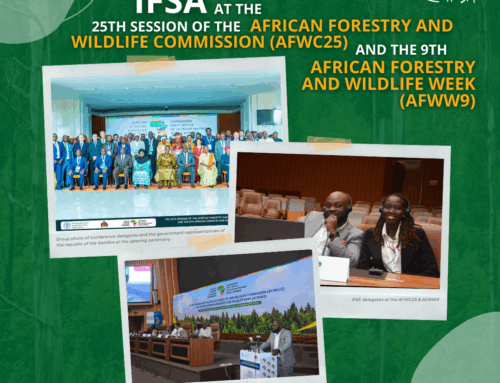

25TH SESSION OF THE AFRICAN FORESTRY AND WILDLIFE COMMISSION (AFWC25) AND THE 9TH AFRICAN FORESTRY AND WILDLIFE WEEK (AFWW9)
“Innovative and Inclusive Forest and Wildlife Resources Management for Africa”
1st – 5th December 2025 in Banjul, The Gambia
Organizer: Food and Agriculture Organization (FAO)
IFSA Delegation Report
Authors: Abalo Theopista, Zebulun Otaigbe Ojo (IFSA Delegates)
The African Forestry and Wildlife Commission (AFWC) of the Food and Agriculture Organization of the United Nations (FAO) held its Twenty-fifth Session in Banjul, The Gambia, from 1 to 5 December 2025 in hybrid modality.
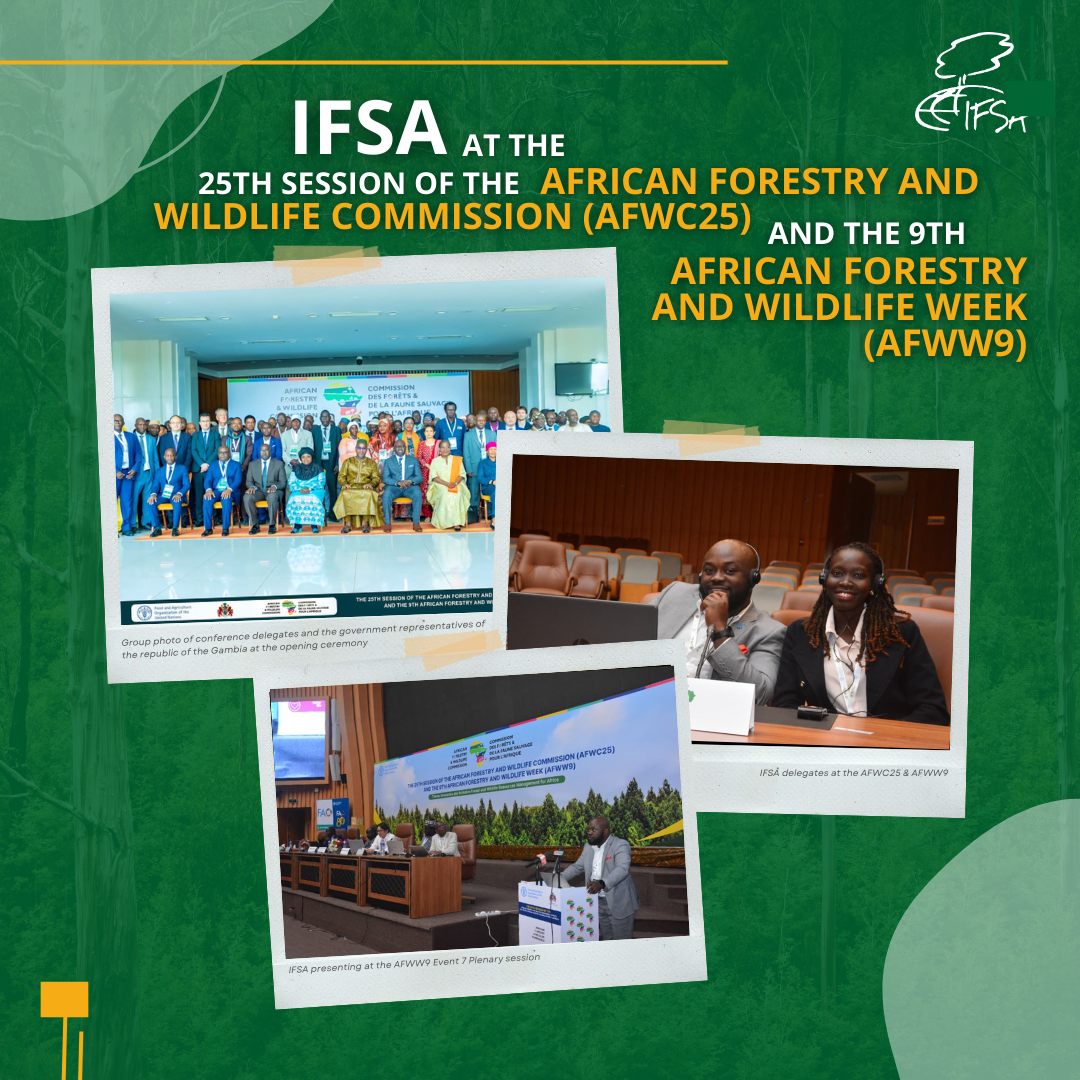
The AFWC25 session, that was held concurrently with the 9th African Forestry and Wildlife Week (AFWW9), served as an important forum for the African member states to advise on the formulation of forest and wildlife management policy, review implementation at the regional level, and exchange information on technical problems. The AFWC25 and AFWW9 sessions theme was: “Innovative and Inclusive Forest and Wildlife Resources Management for Africa”.
The Session was attended by 185 participants (171 in person and 14 virtual), including representatives from 34 Member Nations, as well as observers from other United Nations organizations, intergovernmental organizations, and youth.
IFSA Participation
IFSA was represented by a delegation of two students, Zebulun Otaigbe Ojo (left), a Master’s student from the AUSF LC Viterbo, University of Tuscia, Italy and Abalo Theopista (right), a Bachelor’s degree student from the FAMU LC, Makerere University, Uganda. The IFSA delegates effectively represented the voice of the youth and future leaders in the forestry and wildlife sectors at different sessions, all of which strongly emphasized youth engagement and utilization of available resources for knowledge acquisition and capacity building.
Abalo Theopista contributed to discussions of AFWC25 Item 4, focused on evaluating the progress in implementation of the recommendations of the 24th Session of the African Forestry and Wildlife Commission: FAO supported activities in the region. As a beneficiary of the FAO AIM4Forest Young Forest Champion
Initiative for 2025, she expressed her gratitude for the opportunity, acknowledging the unique experience she acquired throughout the online mentorship sessions and the in country onsite workshop where she was able to learn more about and contribute to the restoration of Mpanga Central Forest Reserve. Her feedback urged the FAO to integrate more practical skill building sessions into the program. As a requirement of the program, she took up the Institutionalization of Forest Data Course, where she was able to learn the basics of National Forest Monitoring Systems and how Institutionalization is relevant for its sustainability. She acknowledged the comprehensive nature and complexity of the course and urged the FAO to establish a mechanism for simplicity of the courses for the benefit of students and other community leaders who might take up these courses in the future.
Zebulun Otaigbe Ojo took part in the AFWW9 Event 7 plenary session focused on the strengthening of crossectoral linkages for Halting deforestation and building resilient Agri-food systems. He provided insights on how youth inclusivity and engagement are the keys to attaining innovation and crosssectionality in both agrifood systems and forestry. He also shared of the collaboration between IFSA and FAO for forest data transperency through the CBIT/ FAO-e learning academy focused on building capacity of the students, academia and young professionals in the Global South especially within Africa in forest monitoring and resources management.
IFSA’s presence at the conference enabled representation of the youth, ensuring that future leadership perspectives were considered in the policy discussions on biodiversity conservation and sustainability.
Core and Daily Agenda
The conference proceeded with a robust agenda guided by the common theme. It focused on strengthening collective action and guiding FAO’s technical support for the coming biennium.
Key Agenda Items and Commission Actions
Opening of the session
The opening session was moderated by Mr. Ebrima Jawara, the Permanent Secretary, Ministry of Environment, Climate Change and Natural Resources of the republic of The Gambia, who welcomed all participants and opened the flow for opening remarks.
Election of the officers
After the adoption of the agenda, the conference proceeded with the election of the Chairperson, Mr. Ebrima Jawara, for the 25th Session of the Commission. This was followed with the election of 3 vice chairpersons each from the three different Sub regions of the AFWC and one Rapporteur who worked together with the FAO reporting team to deliver a draft report at the end of the session.
AFWC25 delegates examined several key priorities for the continent as per the suggested theme and conclusions from the AFWC24 as follows:
Innovative Financing Mechanisms for Forestry and Wildlife
The Secretariat presented document AFWC/2025/6 on “Innovative financing mechanisms for forestry and wildlife,” which the Commission thanked FAO for because of its relevance. The paper discussed global trends in forest finance, including sustainability linked loans and debt for nature swaps. The session emphasized the need for collaboration to address inconsistent policy signals that deter investment and increase transaction costs. Member countries shared updates on national carbon market frameworks, REDD+ readiness, and integrated forest and wildlife financing strategies, while addressing challenges in implementing innovative financing instruments.
The commission encouraged members to:
- Strengthen financing strategies by aligning national policies on climate, biodiversity, and development to create funding path ways, and expand domestic blended finance mechanisms to reduce risk and attract private investment.
- Promote the responsible development of market-linked instruments like carbon credits and green bonds with strong safeguards and equitable benefit-sharing, while enhancing inclusive community-level financial mechanisms and their ties to formal domestic finance.
The Commission recommended FAO to:
- Assist member countries by matching finance sources with stakeholders and enhancing technical capacity to access climate and carbon finance.
- Assist Member countries in developing financial systems that integrate climate and biodiversity goals, while ensuring community-based approaches and compensation schemes benefit local actors.
Sustainable Management of Forests and Wildlife in Small Island Developing States (SIDS).
The Commission took note of the Secretariat report AFWC/2025/4 and the unique characteristics and critical challenges faced by African SIDS, recognizing their limited land, high value ecosystems, and extreme vulnerability to climate change, despite the central role of forests and wildlife in their food security, livelihoods, and coastal protection.
The Commission encouraged Members to:
- Strengthen governance by enhancing legal frameworks for land use and urbanization, while fully integrating forest and wildlife management into biodiversity, climate, and sustainable development efforts, including protected areas and enforcement.
- Boost community engagement with agroforestry and native species encourage private sector adoption of new technologies and advocate for the specific needs of SIDS in continental forums.
The Commission recommended FAO to:
- Support community based restoration and sustainable management while enhancing institutional capacity through knowledge exchange among African SIDS and regional partners.
- Support data collection and monitoring by enhancing platforms like the FRA and updating National Forest Inventories while providing tailored guidance to SIDS on governance and addressing climate challenges such as coastal erosion and sea level rise.
Strengthening Cross Sectoral Linkages for Resilient Agrifood Systems.
Secretariat presented document AFWC/2025/7 on strengthening cross-sectoral linkages. The core objective is to align agriculture and forestry to enhance food security, climate resilience, and biodiversity outcomes while reducing deforestation.
The Commission encouraged Members to:
- Promote integrated land use policies that enhance agriculture-forestry linkages, mitigating trade offs and supporting food security, livelihoods, climate, and biodiversity.
- Promote awareness of trees’ roles in food security through agroforestry and sustainable development, establish incentives, and engage youth to drive innovation.
The Commission recommended FAO to:
- Support members to enhance cross-sectoral policymaking, strengthen policy coherence, and improve monitoring for sustainable practices, emphasizing community and youth involvement.
- Provide technical assistance, technology access, and promote regional cooperation to decouple commodities from deforestation, aiding Member Nations in data production for informed decision-making in forestry and agriculture.
Sustainable Forest-Based Bioeconomy Approaches.
The Secretariat presented document AFWC/2025/5 outlining Africa’s vast potential for a sustainable forest-based bioeconomy that can drive green growth, create jobs, and support climate and biodiversity goals.
The Commission invited Members to:
- Promote practices that minimize resource extraction by emphasizing innovative processing, value addition to underutilized resources, and reusing forest resources.
- Increase local processing capacity to foster enterprise development and job creation for youth and women, leveraging the African Continental Free Trade Area, and strengthen cross-sectoral collaboration to ensure forestry is fully embedded in national bioeconomy policies.
The Commission recommended FAO to:
- Offer technical support to strengthen sustainable resource use, conservation, and the development of bioeconomy value chains that are fully aligned with climate, biodiversity, and livelihood objectives.
- Provide guidance on the role of wildlife-based products and nature-based tourism as contributors to the bioeconomy, and scale up technical support for sustainable bioenergy development.
Delegation Feedback
It was a great honor to represent IFSA at the 25th session of AFWC in Banjul, The Gambia. Here are some of the take home points from the conference.
There is a strong recognition of the need for innovation in forestry and wildlife in Africa, but significant effort is still required to bridge the gap between policy discussions and the practical use of technologies like GIS, drones, and AI at the country level.
The topic of innovative financing including results based financing and carbon trading is moving from theoretical discussion to practice but there still remains an
urgent need for capacity building among African stakeholders to secure and manage these new funding streams effectively.
Youth engagement is recognized as a key element of the AFWC and is essential for embracing the innovative and technological solutions discussed, solidifying their role not just as observers, but as participants, implementers and policy advocates would bring more meaningful impact.
Delegation Outcomes
As IFSA delegates, we were able to:
- Meet forestry experts and wildlife managers, policy-makers from across the continent, expanding our professional network.
- Gain an understanding of pressing policy and financial priorities for Africa’s forestry and wildlife sectors particularly concerning innovation and green bioeconomy development, a topic that resonates with us, as young people.
Recommendation
We recommend IFSA to continue collaborating with FAO, the AFWC and other funding bodies for facilitate and give opportunities for the active participation of youth in the different sessions of the event. This increased youth involvement will ensure that solutions developed are informed by a generation fluent in innovations especially in technology and cross-sectoral collaboration, that the Commission is now prioritizing.
Find more details of the AFWWC25 & AFWW9 here